The story
From a Carolingian palace to a world-renowned chocolate maker. The history of Place Jacques Brel is among the densest in Belgium.
Charlemagne, the most imperial of chocolates
This is the story Denise always told by way of introduction, whenever visitors came to the chocolaterie. The house legend, as it has been passed down in the family.
Once upon a time, in the smiling valley of La Préalle, a cheerful mill sheltered the love of Charlemagne's parents. There, around the year 742, he was born.
On this ground steeped in history, in a magnificent 17th-century farmhouse, a gourmet artist, Denise Courant-Bellefroid, developed an exceptional chocolate and innovated by creating "flavour in the mass": before Charlemagne chocolates, flavour always hid inside the filling or the ganache, wrapped in dark, milk or white chocolate.
Our gourmet artist chose to follow the spirit of nouvelle cuisine: less sugar, less fat, and a return to the natural. Her flavourful creations were rewarded with numerous international prizes and worldwide patents for chocolates with spices, fruits, flowers, coffee and teas.
Today, her son François carries the house forward, true to this great tradition of quality.
Palatium regium
Herstal was one of the centres of power in Europe. Pepin of Herstal, mayor of the palace of Austrasia and great-grandfather of Charlemagne, established his residence here in the 7th century. Between 723 and 920, twenty-three diplomatic acts mention the place, seven of them dated at Herstal itself. The charters call it palatium publicum and then, after the imperial coronation of 800, palatium regium: the palace of the king.
It is in this context that tradition places the birth of Charlemagne in 742, at Herstal or nearby Jupille. Historians still debate the exact place. The link between the Emperor and this land, however, is documented by the charters.
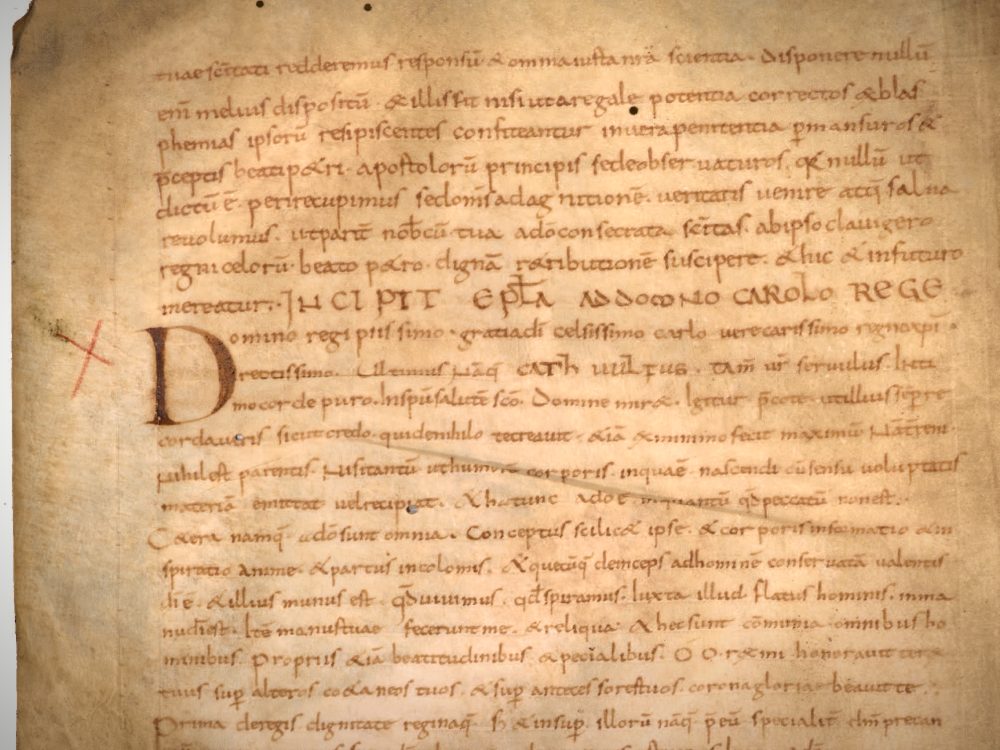
9th-century manuscript · Abbey of Saint-Denis
The Capitulary
of Herstal
In March 779, before an assembly of bishops, abbots and counts, Charlemagne promulgated at Herstal the first great capitulary of his reign. Its twenty-three articles reorganised the religious and public life of the kingdom: the authority of bishops, the punishment of homicide and perjury, the protection of widows and travellers, the regulation of markets and tolls.
It is the first text to use the word capitulare in a legislative sense, and the historian Carlo De Clercq saw in it a founding charter given to all the territories of the Frankish kingdom. Every great text that followed, up to the imperial coronation of 800, proceeds from it. It is in this farm, raised on the palace domain, that the house chose to establish its workshop.
The eight pillars
of the just king
A few years before the Capitulary, a cleric named Cathwulf sent Charlemagne a letter of exhortation listing the eight pillars that uphold the reign of a just king. Fourteen of the twenty-three themes of the Capitulary of Herstal already appear in it. Some historians connect these eight pillars to the octagon of the palatine chapel at Aachen.
After Julien Maquet, The capitulary of Herstal (779) and the letter of Cathwulf to Charlemagne
From the family mill
to the Chain farm
Walloon heritage inventories describe an 11th-century farm built on the site of a mill that belonged to Charlemagne's family. Its Carolingian-era base suggests it was already part of Pepin of Herstal's palace.
The present quadrangular building was erected in sandstone rubble, brick and limestone. Its oldest parts date from the late 16th century, the most recent from the 18th. Until 1795 the farm belonged to the Saint-Mathieu à la Chaîne hospital, hence its other name: the Chain farm. It is also known as the Cajot farm, after the last farmer, who worked it until 1985.
Denise, then
François.
Denise Courant-Bellefroid set up her chocolate workshop within the farm walls. There she developed the process that would bring the house worldwide renown: infusing natural essential oils into the chocolate mass. This patent would raise the house among the most innovative chocolate makers in the world.
Trained in the hotel trade in Liège, Denise had developed a passion for the history of cooking, above all that of the Middle Ages and the Renaissance. This gourmet erudition, joined to an exceptional palate, gave birth to the founding idea: marrying cocoa with spices, fruits, flowers, coffee and tea.
Today her son François Courant-Bellefroid leads and develops the house, carrying the family heritage to new markets, from Japan, where the house has been present since the 2000s, to connoisseurs worldwide.
“Thirteen centuries of history beneath our feet. Every chocolate carries its memory.”
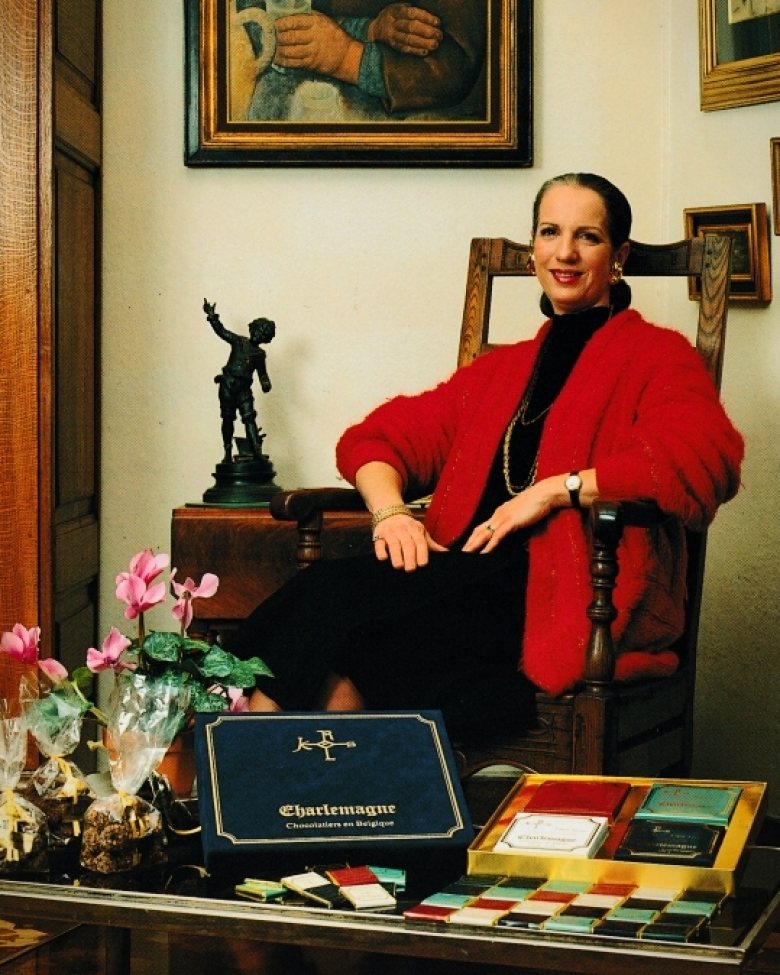
Founder
The signature
of Karolus
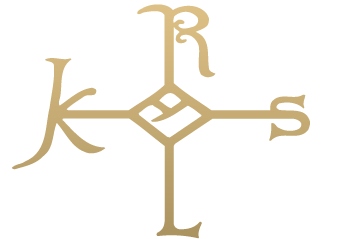
Charlemagne probably could not write fluently. To sign his acts he used a monogram: the letters K, R, L and S of Karolus, arranged around a central lozenge to form a cross. The sovereign himself drew the final stroke at the centre, thus validating charters and capitularies by his own hand.
This sign, one of the most famous of the Middle Ages, is today the registered trademark of the house, filed with the European Union Intellectual Property Office. Every Charlemagne box bears the Emperor's very signature.
The navy and gold of our boxes are no recent choice: they have accompanied the house since its earliest years, stamped with the monogram of Karolus.
Eight centuries under
the Principality of Liège
After the Carolingian era, the land of Liège wrote one of Europe's most singular political histories. Around 980 Bishop Notger obtained temporal power over the city: thus was born the Principality of Liège, an independent state within the Holy Empire, governed by its prince-bishops for more than eight hundred years, until 1795.
Herstal held a place apart. A free seigneury, the land of Herstal long belonged to great European houses, including Orange-Nassau, before being bought in the 18th century by the Prince-Bishop of Liège. Birthplace of the Carolingian dynasty turned coveted enclave, it crossed the centuries keeping its own identity.
From this history the region inherits a temperament: a taste for independence, pride in the work of hands, and the Mosan art that made the goldsmiths of the Meuse shine across Europe. It is this lineage of artisans that the Charlemagne house carries on, within its walls at La Préalle, since 1974.
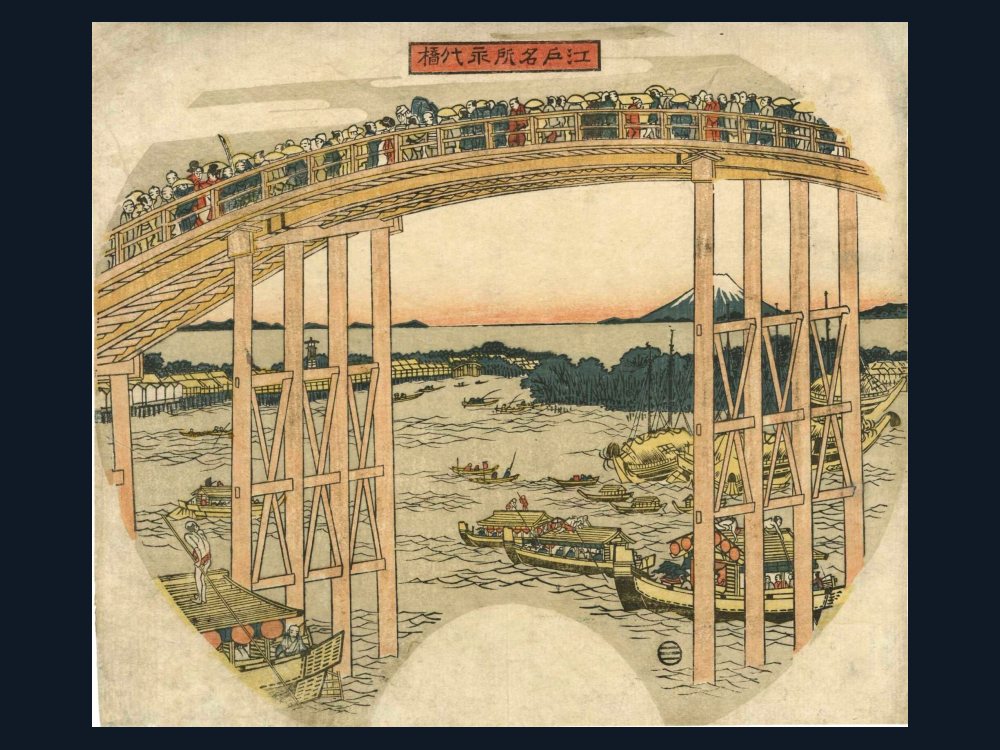
Woodblock print · Chikuma founded at its foot in 1688
To our friends at
Chikuma Miso
By the Sumida River, at the foot of Eitai Bridge, a house has kept its name since 1688. Chikuma Miso, once honoured by the visit of the forty-seven rōnin of Akō and celebrated on the kabuki stage, measures time as we do: in centuries, in gestures handed down, in loyalty. May the house of Edo that grants us its trust receive here the respectful salute of the house of Herstal. Two distant lands, one same patience.