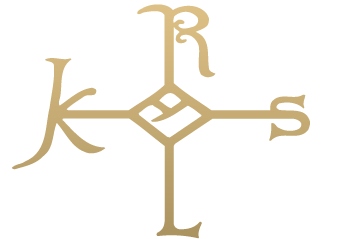
On the lid of our boxes, a sign. Four letters arranged in a cross around a lozenge, traced in gold on midnight blue. This is not a logo drawn by an agency. It is how Charlemagne signed.
The sign is today our house's registered trademark. It deserved to have its story told, above all what it says precisely, since its true singularity is rarely explained.
Signing without writing
In the early Middle Ages, writing was not a ruler's skill. It was a craft, practised by trained clerics in organised chanceries. A king governs, dictates, decides. He does not write.
Yet he had to validate. A diploma, a donation, a capitulary carried force only if authority engaged with it in a way that was recognisable and hard to imitate. From this need arose a practice that would last eight centuries: the signum manus, literally the sign of the hand.
The custom is attested from the Merovingian period, in the fifth century, and continues into the fourteenth across the Frankish Empire and the kingdoms that succeeded it. The earliest surviving Merovingian royal charters, in the seventh century, bear monograms enclosed in a frame. The Merovingian kings then abandoned the practice in favour of the wax seal and the signature written out in full.
The modified cross reappears at the end of the seventh century and the start of the eighth, simultaneously in Frankish Gaul and in Anglo-Saxon England. It is from this stock that Charlemagne's sign descends.
769, the birth of a sign
Charlemagne uses his cruciform monogram for the first time in 769. He is then about twenty years old and has reigned for a year. He would use it until the end of his reign, forty-five years later.
The model probably came from Rome. Popes and Eastern emperors had long used cruciform monograms to authenticate their acts: that of Justinian in the sixth century, of a Byzantine emperor combining the letters of Rome and his own name, of an eighth-century pope formed from the letters of Gregory. Adopting this form, for a Frankish king, was not an aesthetic choice. It was placing himself in continuity with an imperial and pontifical authority.
The monogram reads as follows. At the four ends of the cross, the consonants of the Latin name: K, R, L, S, for Karolus. At the centre, the lozenge is no ornament: it results from the superimposition of the vowels A, O and V, the V standing for U in Carolingian script. The four arms and the heart of the sign therefore contain the whole name.
Nothing is left to chance. The cross is at once an instrument for reading and a profession of faith.
A single stroke by his hand
Here is the detail almost no one mentions, and it changes everything.
The monogram was not drawn by Charlemagne. It was traced by the chancery scribe, along with the rest of the document, in a careful and regular script. The emperor added only one thing: inside the central lozenge, a small stroke in the shape of a V.
Palaeographers call it the stroke of execution, or the completion stroke. It is the only autograph part of the document. On the diploma issued at Kostheim on 31 August 790, as on other surviving acts, it is this tiny V, and it alone, that was traced by the sovereign's own hand.
Everything else could be prepared in advance. Validation hinged on this final, brief, irreplaceable gesture. A document without this stroke was only a draft.
An emperor's signature came down to a single line.
What Charlemagne could do
His biographer, who knew him and wrote his life around 830, reports that he could read, took an interest in letters, and gathered around him the most learned court in the West. He also reports that Charlemagne had taken up writing late, keeping wax tablets under his pillow to practise at night, and that he never mastered it well.
This has long been read as a weakness. It says something else. An eighth-century sovereign no more needed to write than a modern head of state needs to lay out a page. What mattered was the ability to validate, and for that he had a sign no one could reproduce without being exposed.
This same man had thousands of manuscripts copied, imposed a legible script across the whole Empire, the Carolingian minuscule, from which our printed letters directly descend. The man who wrote badly reformed the writing of Europe.
The sign that outlived the Empire
The royal monogram did not die with the Carolingians. It passed into the chanceries that succeeded them. Capetian diplomas, until the twelfth century, still bear a monogram that the formularies name with a revealing word: karacter, the character, in the sense of a person's own mark.
The practice then gave way to the wax seal and the handwritten signature. It had lasted eight centuries.
Why this sign, here
Our workshop occupies a farm raised on the former Carolingian palatial estate of Herstal, where Charlemagne promulgated in 779 the first great capitulary of his reign. By that date, the monogram had already been in use for ten years. It stood at the foot of those very texts.
The sign is today the house's registered trademark, filed with the European Union Intellectual Property Office. It is stamped in gold on every box. It is not a medieval ornament added for the sake of appearing old: it is the authentic signature of the man who governed from this place.
And the detail of the final stroke matters to us particularly.
In a workshop, almost everything can be prepared. The couverture is melted, tempered, the moulds are filled, the ganaches rest. Then comes a brief gesture that decides: the rolling of a truffle, the check of a piece before it leaves, the rejection of one that will not. This gesture cannot be delegated. It stands as a signature.
Charlemagne validated a capitulary with a stroke of the pen no longer than a fingernail. We validate a piece with a glance. It is the same principle, and that is why this sign suits us.